
How to Build a Go-to-Market Strategy for Your Startup (2026 Template + Framework)
A practical 7-step GTM framework for early-stage startups, with a free template and a real SaaS example.
TL;DR
A go-to-market (GTM) strategy is the playbook that turns "we built a product" into "we have customers who pay and stay." For an early-stage startup, a good GTM strategy answers three questions: who is the smallest viable customer, what specific problem you solve better than the status quo, and how they will discover, try, and buy.
This article gives you a 7-step framework, a copy-paste template, and one rule most founders ignore: your GTM is a hypothesis, not a plan.
What is a Go-to-Market Strategy?
A go-to-market strategy is the operating model your company uses to acquire its first 100, 1,000, and 10,000 customers. It includes your ideal customer profile (ICP), positioning, pricing, channels, messaging, and the metrics you'll use to know if any of it is working.
It is not a marketing plan. Marketing is one execution layer inside the GTM. A GTM also covers product packaging, sales motion (PLG, SLG, hybrid), pricing model, and even who you decide not to serve.
Why Most Startup GTM Plans Fail
Most early-stage GTM decks fail for one of three reasons:
- The ICP is too broad. "SMBs in North America" is not an ICP. "12-person agencies running paid ads for DTC brands" is.
- The channel doesn't match the customer. Selling a $49/mo tool with a 6-month enterprise sales cycle is a math problem you cannot win.
- No feedback loop. Founders launch, get silence, and pivot the product instead of the GTM. Usually the product is fine; the GTM is wrong.
The fastest fix is to treat GTM as a series of cheap, falsifiable bets — not a master plan you commit to for 12 months.
The 7-Step GTM Framework
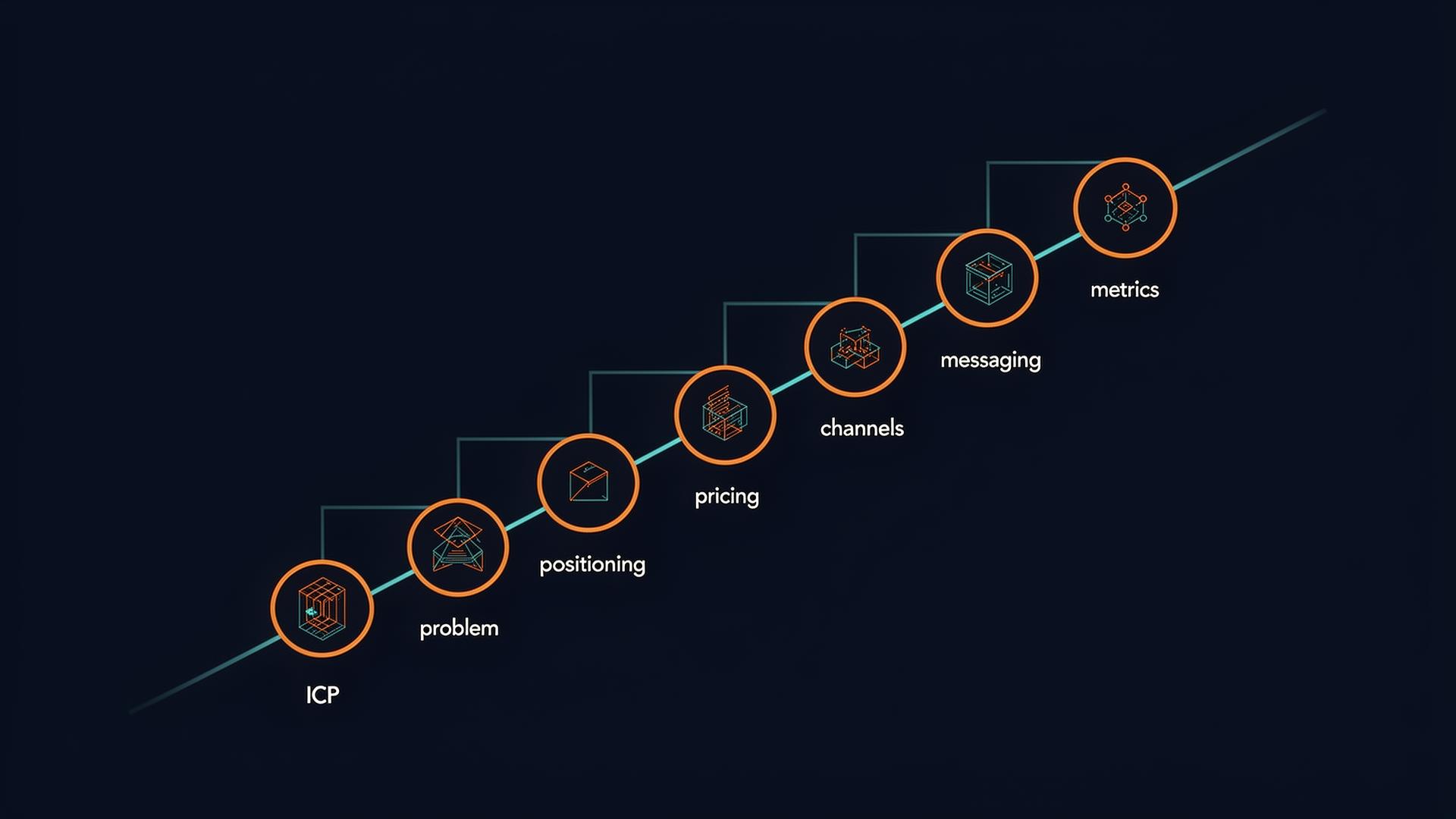
1. ICP — Define your smallest viable customer
Pick one customer segment so specific you can name three real companies (or people) who fit. Include: company size, role of the buyer, current tool/workaround they use, and the trigger event that makes them care.
Tip: read 50–100 real reviews of the closest existing alternative — the language your future customer uses is sitting there in plain text.
2. Problem — Validate the pain is real and urgent
Rank the problem on two axes: frequency (daily vs yearly) and severity (annoying vs costing real money). You want top-right. Anything in the bottom-left becomes a "vitamin" — nice to have but no one buys urgently.
3. Positioning — Pick a category of one
Use this one-sentence template:
For [ICP] who [trigger / pain], [product] is the [category] that [unique mechanism], unlike [main alternative].
If you can't fill it without weasel words, your positioning isn't ready.
4. Pricing — Match the buyer's mental model
Self-serve users want a free tier and predictable monthly pricing. Procurement-driven buyers want annual contracts with a quote. Don't mix the two motions in your first 12 months. Pick one.
Rule of thumb: charge enough that 100 customers covers a $300k ARR target. If your price needs 10,000 customers to matter, you're playing a different game (one that needs $5M+ to fund).
5. Channels — One channel until it breaks
You don't need 6 channels. You need one that compounds. Realistic options for early-stage startups:
| Channel | Best when | Time to first customer |
|---|---|---|
| Founder-led outbound | High ACV, niche ICP | Days |
| SEO + content | Searched-for problem | 3–9 months |
| Community (Slack/Discord/Reddit) | Pain shared in public | Weeks |
| Partnerships | Buyer already inside another tool | 1–3 months |
| Paid ads | Proven LTV, repeatable funnel | Days (but burns cash) |
Pick one. Run it for 90 days. Measure CAC and conversion. Then add a second.
6. Messaging — Use their words, not yours
The biggest unlock in early-stage marketing isn't a clever tagline — it's mirroring the exact language your ICP uses to describe their pain. Pull that language from reviews, sales calls, and support tickets.
This is, by the way, exactly what iCanGTM does: it reads real reviews and gives you the words, fears, and triggers your ICP actually uses.
7. Metrics — Three numbers, refreshed weekly
Don't track 40 metrics. Track three:
- Activation rate — % of signups who reach the "aha" moment in week 1
- CAC payback — months it takes a customer to pay back what you spent to acquire them
- Net revenue retention — does a $1 cohort grow to $1.10 a year later, or shrink to $0.70?
If activation is broken, fix the product. If payback is broken, fix the channel. If retention is broken, fix the ICP.
Free GTM Strategy Template
Copy this into a doc and fill it in. If a row takes you more than 2 sentences, you don't know it well enough yet.
| Block | Your answer |
|---|---|
| ICP (one sentence) | |
| 3 real companies that fit | |
| Trigger event | |
| Top problem (frequency × severity) | |
| Positioning sentence | |
| Pricing model + entry price | |
| Primary channel for next 90 days | |
| Top 5 phrases your ICP actually uses | |
| North-star metric | |
| Activation, CAC payback, NRR targets |
Want this auto-filled from real reviews of your category? Drop screenshots into iCanGTM and you'll get the ICP, the empathy map, the keywords and a content plan in under 5 minutes.
Real Example: A SaaS Startup Walkthrough
Imagine NotionGantt, a fictional plugin that adds Gantt charts to Notion.
- ICP: Operations leads at 20–80-person remote startups already paying for Notion Team plan.
- Problem: Project timelines are unreadable in Notion's native database view; they currently export to Excel weekly.
- Positioning: "For ops leads at remote startups who keep projects in Notion, NotionGantt is the visual timeline layer that turns any database into a Gantt in one click — unlike exporting to Excel every Monday."
- Pricing: $9/user/month, 14-day free trial, no credit card.
- Channel: SEO targeting "notion gantt chart", "project timeline in notion", plus partnership with 3 Notion consultants.
- Messaging: Pulled directly from r/Notion and Notion-template reviews.
- Metrics: Activation = "first Gantt rendered" within 24h; CAC payback < 6 months; NRR > 110%.
Notice: every block is concrete. There's no "we'll do content marketing." That's where most decks die.
Tools You'll Need
You can run an early-stage GTM with embarrassingly few tools:
- Voice-of-customer mining: iCanGTM (this site) — extracts ICP, fears, triggers, JTBD and a content plan from review screenshots.
- Outbound: Apollo, Instantly, or just a Google Sheet for the first 100 prospects.
- Analytics: PostHog or Plausible — pick one, don't pick both.
- CRM: Notion or Airtable until you have 50+ active deals. Then HubSpot free.
Resist the urge to buy a stack before you have customers. Every tool you add is a tax on your weekly review.
FAQ
How long should an early-stage GTM strategy be?
One page. If it takes more, you don't know it well enough. Investors and your team should be able to read it in 90 seconds.
What's the difference between a marketing plan and a GTM strategy?
Marketing plan = how you generate awareness and demand. GTM strategy = the full system, including ICP, pricing, sales motion, channels, and the metrics that prove it's working. Marketing is one layer inside the GTM.
When should I revisit my GTM strategy?
Every 90 days for the first two years, or any time a key assumption breaks: CAC doubles, churn spikes, a new competitor reframes the category, or you cross a major revenue milestone (e.g. $100k → $1M ARR).
Should I use a PLG or sales-led motion?
Match the price and decision-maker. If a single user can decide and the price is under ~$100/mo, lean PLG. If the buyer is a director+ and the contract is $10k+/year, lean sales-led. Don't try to do both in year one.
How do I find my ICP if I haven't launched yet?
Look at the reviews of the closest existing tool — your future customers are already complaining about it in public. Pull the language they use, then go interview 10 of them. That's your ICP draft.
Next step
Stop guessing what your customers want. Drop 30 screenshots of real reviews (yours or your competitors') into iCanGTM and get an ICP, empathy map, keywords and a content plan tailored to your market — in 5 minutes.